Prove your autonomous forklift in your warehouse. Before it drives there.
Forge's AI rebuilds your racking, docks and aisles, your forklift and its sensors, then writes the forklift edge cases (people at aisle ends, loads at height, trailers and glare) and shows you where it fails and how close it came. Shown for autonomous forklifts; the same workflow runs for any mobile robot on your floor.
The deployer's problem
Automation arrives one vendor at a time. Your floor runs all of them at once.
Every OEM proves their robot in a demo built for their robot. Nobody proves it in your building, against your processes, alongside everything else that moves there.
Truck arrives on siteDemo in a cleared area goes perfectly
Stops short in morning glareCamera washed out · shift delayed
Near-miss at an aisle endFleet paused pending safety review
AMR and forklift deadlockTwo vendors, two tickets, nobody owns it
WMS handoff drops a taskPallet sits in staging all night
Fleet finally scaledNobody can say what the next update brings back
from first pilot to a fleet you can rely on
Each edge case waits for the real world to produce it, one at a time, with people nearby.
and every one tested in isolation
Forklifts, AMRs, sortation, a WMS: each OEM validates their own product. The interactions between them belong to you.
not benchmarks
An OEM can prove their truck stops for a person. Only you can define the test that decides whether the automation pays off: “Can this fleet clear Dock 4 before the 6 a.m. wave?”
after every software update
What passed at go-live quietly changes with each release, on every vendor's schedule, not yours.
Forge gives deployers what an OEM can't: one twin of your site where every modality of automation is tested against your use case, before go-live and after every update.
// 01 Where forklifts fail
What an autonomous forklift has to survive.
These are the conditions that decide a real deployment - and the ones a scripted demo never shows. Forge reproduces them by the thousand, before your robot ever reaches a customer floor. You choose which moments matter for your site and how hard to push each one.
// 02 Forge builds your world
Your warehouse and your forklift, built by Forge, checked by you, tuned to behave like the real thing.
Describe the site and import the truck. Forge builds the racking and docks, tunes how the forklift brakes and lifts with and without a load, and calibrates the sensors it relies on.
Scene
Your warehouse
Seven aisles of selective racking, four dock doors, a pedestrian walkway along the south wall.”
- Racking with real beam heights
- Dock doors, plates and trailers
- Aisles, lanes and walkways
Robot
Your forklift
Import the truck model. Forge's AI maps the mast, carriage and forks, then tunes it against real test data.
- Mast, carriage and fork geometry
- Counterbalance and load curves
- Braking with and without a load
- Your navigation and safety stack, connected as-is
Sensors
Its sensors
Forge's AI places and calibrates the sensors the forklift relies on to see people, pallets and racking.
- Safety LiDAR warning and protective fields
- Fork-tip and pallet cameras
- Realistic glare, dust and noise
// 03 Forge writes your tests
Forklift test suites, ready on day one.
Start from suites written for forklifts. Forge's AI adapts each scenario to your warehouse and your truck and suggests the edge cases worth running. You decide what goes in the suite.
Safety
- People at aisle ends and crossings
- Speed zones and slow-downs
- Emergency stop and field switching
- Blind corners and mirrors
Operations
- Put-away and retrieval at height
- Picking from floor and stacks
- Trailer loading and unloading
- Staging-lane handoffs
Integration
- Warehouse system task handoff
- Traffic rules with manual trucks
- Charging and parking
- Fleet commands
Reliability
- Full-shift endurance runs
- Dirty lenses and sensor wear
- Regression on every release
- Recovery after a stop
// 04 The verdict
Is it ready for your floor? Here's the evidence.
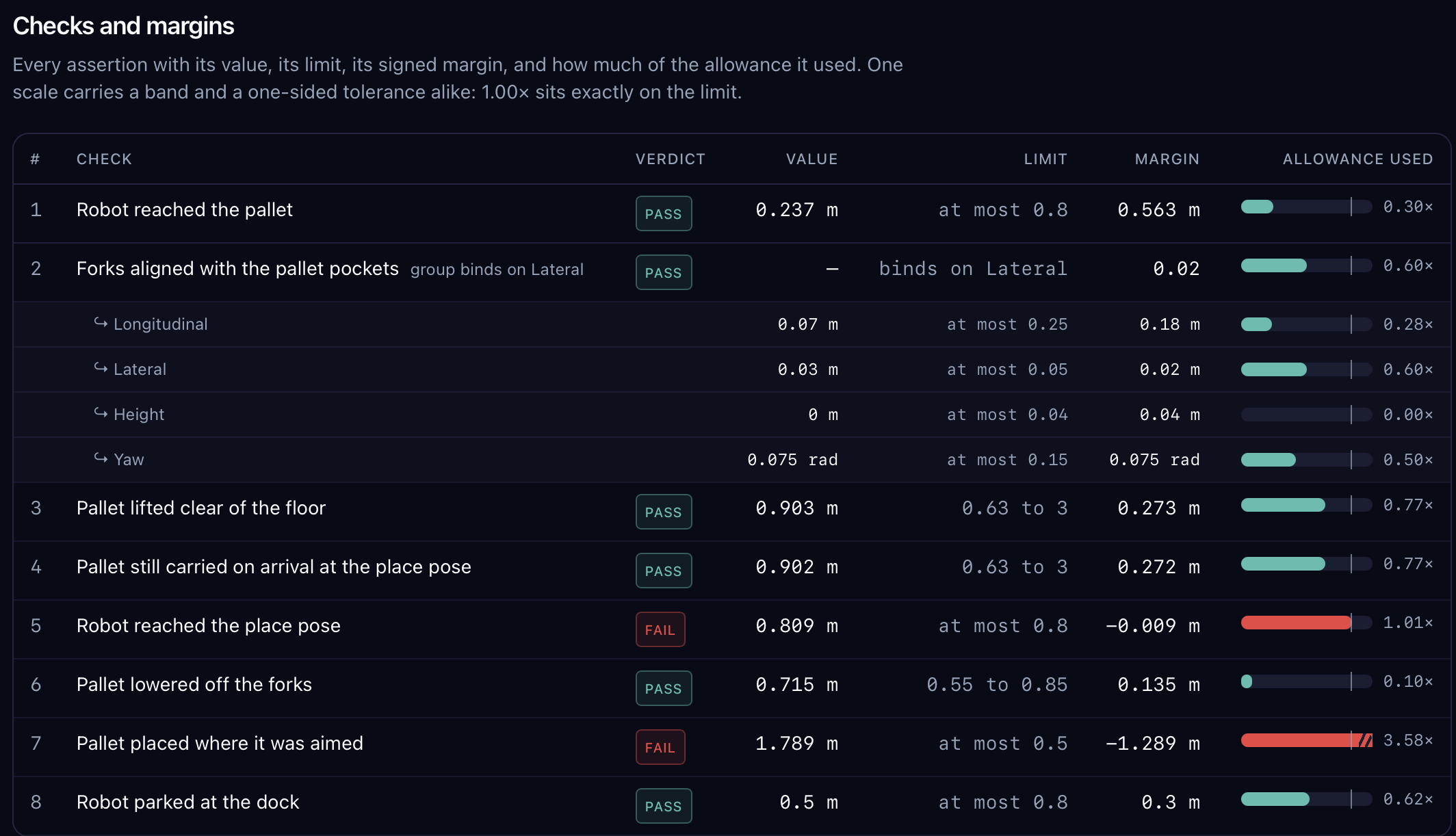
Every run is graded against the limits that matter on a real site: stopping distance to a person, placement, clearance and throughput. Forge rolls the runs up into a readiness verdict you can take to operations, safety and finance, and a replay for anything that failed.
What the readiness report answers
- Is it ready to go live?Pass, fail or needs attention, by suite: safety, operations and integration, with the count of runs behind each verdict.
- What would fail on my floor, and where?Each failed run in plain language: which dock, which aisle, which shift condition, and by how much it missed the limit.
- Has an update broken anything that used to work?The same suite re-run on every vendor release, with what held, what was fixed and what regressed.
- What do I hand to safety and finance?A standards-traceable record (ISO 3691-4, ANSI B56.5, VDA 5050), the replay of every failure, and the vendor's root cause once they've worked it.
Every verdict is on the software the vendor will actually ship to you, not on a demo build.
50 of 52 ready · 2 need attention before go-live
NOT YET- SAF22 / 22READY
- OPS17 / 181 OPEN
- INT11 / 121 OPEN
- Pallet placed 1.3 m off target at Dock 4, low light, 1.6 m/sOPS-06 · limit 0.5 m · replay ready · vendor root cause pendingFAIL
- Deadlock at the charging bay with a manual truck in the laneINT-04 · vendor fix in 3.3 · re-test scheduledFAIL
- Person steps out at the end of Aisle A-7, shift changeSAF-01 · stopped at 0.62 m · limit 0.50 mPASS
- Glare through the east dock doors, 07:10SAF-09 · fixed since release 3.1FAIL→PASS
// 05 Who it's for
For the teams who deploy robots, the teams who sell them, and the teams who integrate them.
Warehouse & logistics operators
Test a forklift against your own racking, dock doors and shift patterns before go-live. Share pass or fail with safety and operations, with no engineering team required - your operations and safety people review the runs.
Book a demo for operatorsOEM sales and field teams
Rebuild the prospect's site from a description or a walkthrough video, run your robot through their busiest hour, and turn a site visit into a proof pack in days instead of a pilot in months - their own aisles, docks and shift patterns, graded.
Book a demo for sales teamsSystem integrators
Commission the forklift, the fleet manager and the WMS on one simulated floor before the site is live. Prove traffic rules, VDA 5050 handoffs and mixed traffic with manual trucks, and hand the customer a commissioning record they can audit.
Book a demo for integrators// 06 Questions
Forklift questions, answered.
What Forge does to your navigation stack, which standards the suites reference, and what a verdict actually tells you.
What conditions cause autonomous forklifts to fail in real deployments?
The six that decide most deployments are people stepping out in shared aisles, pallet engagement with leaning, wrapped or damaged pallets, docks and trailers (misalignment, plate gaps, creep), degraded perception from dust, glare and reflective floors, mixed-fleet traffic with manual trucks and other vendors' robots, and narrow-aisle, high-rack work where mast sway and tight clearance turn small errors into contact.
Do I need a simulation team?
No. Forge's AI builds the twin, imports and tunes the truck, calibrates the sensors and drafts scenarios. Your team describes the site, reviews what is proposed and decides what counts as a pass. Warehouse operators use Forge without an engineering team.
How long does it take to get a first result?
Bring one aisle or dock that worries you to a 30-minute demo; we rebuild it and run your scenario during the session. A full site twin with the standard suites typically follows within the first weeks of an evaluation.
Can Forge test my forklift's own navigation and safety stack?
Yes, and only that. Forge models the truck's physics - mast, carriage, forks, counterbalance, braking with and without a load - and its sensors. Your navigation and safety stack connects as-is over ROS and drives the truck. Forge never modifies or retrains it.
What does a forklift verdict look like?
Each run is measured against the limits that matter for a forklift: stopping distance to a person, placement offset at height, mast sway and fork-entry clearance. Forge reports the worst case across the sweep (for example, 1.6 m/s on a wet floor in low light), which limit was missed and by how much, and lets you replay that exact run.
How does Forge model my warehouse?
From a description or walkthrough video, Forge builds racking with real beam heights, dock doors, plates and trailers, aisles, lanes and walkways, and names each area so scenarios can reference it. Your team reviews the layout and corrects anything that does not match.
Does Forge support ISO 3691-4 and ANSI B56.5 test scenarios?
Yes. The Safety suite is seeded from an ISO 3691-4 test-category matrix and covers ANSI B56.5 topics such as people at aisle ends, speed zones, emergency stop and protective-field switching. Each result is traceable to the requirement it was written against.
Can Forge test mixed traffic with manual forklifts and other vendors' robots?
Yes. The Integration suite covers right of way, crossings, deadlock, manual drivers who do not follow the robot's rules, and VDA 5050 task handoff from a WMS or fleet manager.
Also for OEMs
Building the robot rather than deploying it?
Forge takes the grunt work out of simulation and hands your engineers a root cause. Your stack runs unmodified.
Book a forklift demo
Bring us the aisle that worries you most.
We'll rebuild it, run your forklift through it and walk you through the verdict in 30 minutes.